
 Українська
 Русский
Navagraha Tour: 9 Planets, 5 Elements, Power Places of South India
Astrological Tour of 9 Planet Temples in Tamil Nadu.
This tour will be of interest to those interested in Jyotish, Indian Astrology, Hinduism and Indian culture.
The highlight of this tour is the Navagraha Parikrama, a visit to the temples of the 9 planets located around the holy city of Kumbakonam.
We will visit these temples as tourists and as pilgrims.
In each temple, brahmins will perform pujas for us at the altar of one or another planet.
This will remove adverse influences and propitiate the planets, because behind each planet there is a personality!
About the tour:
Power Places of South India. Temples of the 9 Planets. 5 Elements.
Places to visit:
Trivandrum, Kanyakumari, Rameshwaram, Tiruchirapalli, Kumbakonam, Chidambaram, Thanjavur, Tiruvannamalai, Kanchipuram, Vellore, Sri Kalahasti, Chennai.
In Vedic astrology, it is believed that each of the nine celestial bodies (Navagrahas) possesses a unique energy and has a specific influence on the human mind. The energies of the Grahas connect with a person’s aura at the moment of birth and remain throughout their life.
Sanatana Dharma teaches that by worshipping the deity representing each of the Grahas, one can improve the areas of life that are influenced by them according to their position in the natal chart.
As early as 499 AD, the Indian astronomer Aryabhata proposed a planetary model in which planets move in elliptical, not circular, orbits.
In India, the naming system is based on the Navagrahas, which includes seven traditional planets — Surya (Sun), Chandra (Moon), Budha (Mercury), Shukra (Venus), Mangala (Mars), Brihaspati (Jupiter), and Shani (Saturn), as well as the ascending and descending lunar nodes — Rahu and Ketu.
India is home to many unique temples dedicated to the Navagrahas. The most famous of them are located in Kumbakonam, known as the “City of the Pot” (Tamil Nadu). The name Kumbakonam comes from the Sanskrit word kumbha — a pot filled with the nectar of immortality (amrita).
According to a local legend, the Gods and Asuras quarreled over who should possess the pot of amrita. It was accidentally broken by an arrow shot by Shiva. From its shards, Shiva formed a lingam, which is now located in the sanctum of the Kumbeshwara Temple. The spilled nectar filled the Mahamakham tank in the city.
Kumbakonam is said to be the exact place where the pot of immortal nectar was washed by a great flood from the sacred Mount Meru in the Himalayas.
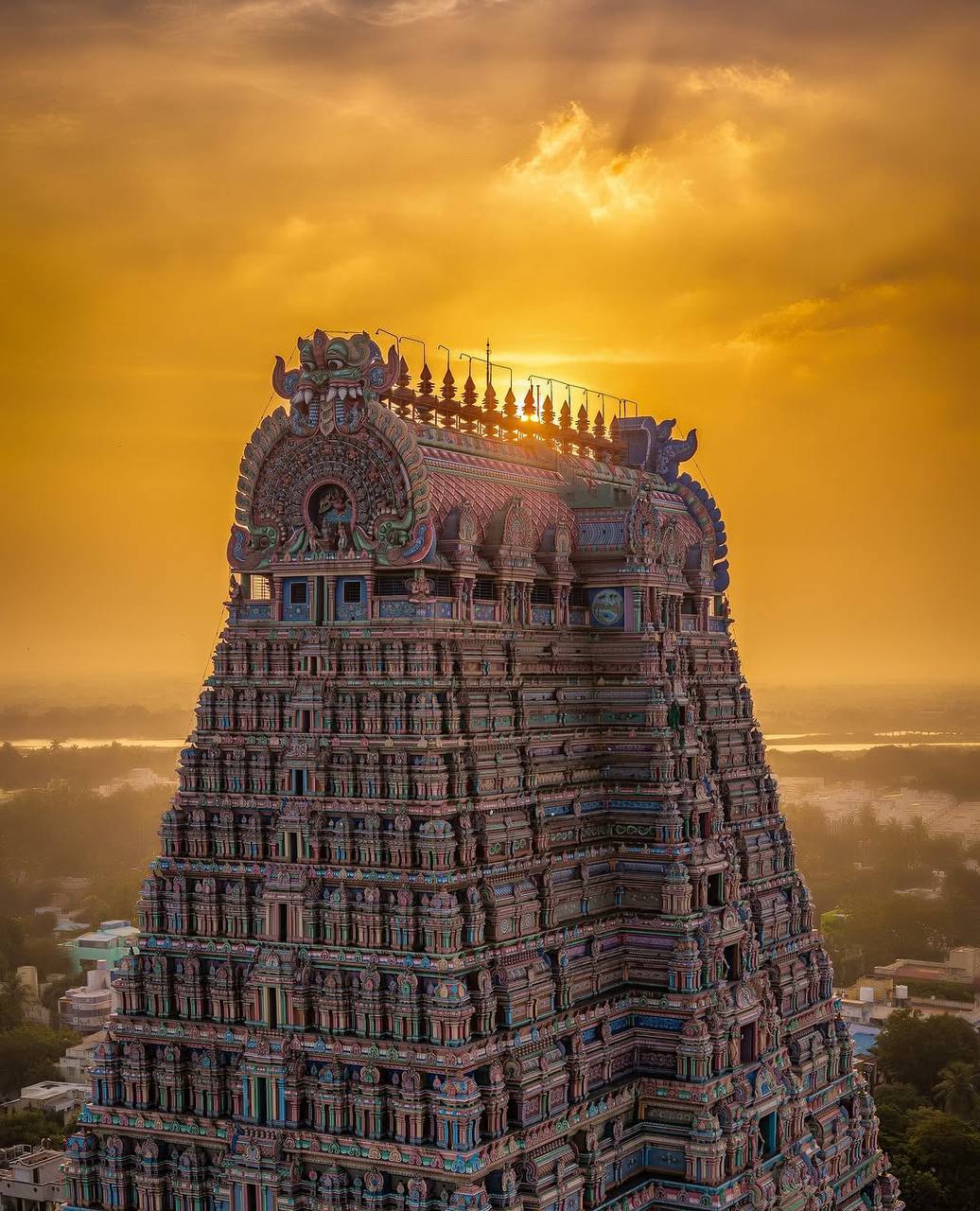
There are over 80 temples in Kumbakonam, many of them very ancient. The Shaivite Kumbeshwara Temple was built in the 17th century. Its nine-tiered eastern gopuram (gateway tower) is 39 meters tall. The temple is richly decorated with intricate carvings depicting scenes from the Puranas, the 12 zodiac signs, and the 27 nakshatras (constellations). The main lingam in the sanctum is considered swayambhu — self-manifested. According to legend, Shiva created it from the fragments of the broken nectar pot.
Sarangapani Temple
The largest Vaishnava temple in Kumbakonam is Sarangapani Temple, which is designed in the form of a chariot drawn by horses and elephants, each weighing around 300 tons.
The sanctum contains a hall with 100 pillars. The inner temple structures in the form of a chariot date back to the 13th century. The Rajagopuram (main gate tower) has eleven tiers, stands 53 meters high, and is decorated with erotic bas-reliefs.
Temples of the 9 Planets in and around Kumbakonam:
Sun Temple
The Suryanar Temple is dedicated to the Sun (Surya).
It was built by King Kulothunga Chola I in 1100 AD. The main deity here is Suryanarayana, seated in a solar chariot.
According to legend, the sage Kalava suffered from leprosy. He prayed to the nine planetary deities, and they, pleased with his devotion, cured him. However, when Brahma, the god of creation, learned of this, he cursed the nine planets and sent them to Earth. The planets prayed to Shiva to lift the curse. Shiva appeared and declared that this place would now belong to them and that they would bless anyone who came to worship them here.
Moon Temple
In the small town of Thingalur, located about 33 kilometers from Kumbakonam, there is a temple dedicated to the Moon (Chandra). It is believed that those who visit this temple gain strength and are freed from stress and mental burdens.
According to legend, it was here that Chandra (the Moon) performed penance and worshipped Shiva, receiving his divine blessings.
Therefore, the principal deities enshrined in this temple are Shiva and Devi (Goddess Parvati).
Mercury Temple
The Mercury Temple is mentioned in the epic Ramayana, and it is believed that the oldest part of the temple is over 3000 years old.
This temple is an extensive complex, consisting of three large sacred tanks and five temple structures.
The three water tanks symbolize the three eyes of Shiva — Chandra (Moon), Surya (Sun), and Agni (Fire).
The Mercury Temple is known for bestowing wisdom and knowledge upon devotees.
According to legend, it was in this temple that Shiva performed the sacred Ananda Tandava — the “Dance of Bliss”, a cosmic dance embodying the laws of existence.
The dance consists of 108 movements, each containing a deep symbolic meaning about the workings of the universe.
It is believed that anyone who can perfectly replicate this dance will attain complete understanding of cosmic secrets.
Within the temple stands a representation of Nataraja, the dancing form of Shiva.
Venus Temple
The Kanchanur Temple, located in the quiet village of Aduthurai, is dedicated to Venus (Shukra) — considered the most auspicious planet after Jupiter.
Venus is associated with wealth, pleasures, beauty, and prosperity.
It is believed that it was at this very site that Shiva granted Venus the status of a celestial planet.
Mars Temple
The temple located in the town of Vaithiswaran Koil is dedicated to Mars (Mangala).
This place is also associated with Vaithiswaran, the god of medicine, whose name is derived from the name of the town.
Pilgrims visit this temple to receive healing and energetic strength from the planet Mars.
Jupiter Temple
The Jupiter Temple is situated in the town of Alangudi.
The presiding deity here is Shiva in the form of Dakshinamurti, the divine teacher who grants knowledge and spiritual wisdom.
According to legend, it was in this very place that Shiva drank the poison (halahala) that emerged during the churning of the Ocean of Milk — a poison capable of destroying the universe.
It is also said that Parvati performed penance here in order to marry Shiva.
Saturn Temple
The Shaniswaran Temple in Thirunallar is dedicated to Saturn (Shani).
Although it is a Shaivite temple (dedicated to Shiva), thousands of people visit this place to seek relief from the malefic effects of Saturn in their astrological charts.
Bathing in the sacred waters of this temple is believed to remove misfortunes and suffering caused by Saturn.
Rahu Temple
The Rahu Temple is located in a town called Tirunageshwaram. The main deity of the temple is Naganathaswami – Shiva, the Lord of Serpents. The temple complex was built during the Chola dynasty in the 10th century. According to legend, Indra, the deity of the Rigveda, also performed penance here.
Ketu Temple
Two of the nine Navagraha—Rahu and Ketu—do not correspond to any real celestial bodies, but they are considered “imaginary planets,” responsible for solar and lunar eclipses and for many aspects of the horoscope. In the Ketu Temple, Shiva performed penance to rid himself of sins.
According to legend, Vishnu decided to give the nectar of immortality, amrita, only to the gods (Devas), so the demons (Asuras) would not gain immortality. However, one of the Asuras tricked his way into obtaining the nectar, and the Sun and Moon exposed him as a liar. Vishnu severed his head from his body with his divine discus. Thus, the demon became the two personalities, Rahu and Ketu. Rahu and Ketu performed numerous penances devoted to Shiva and earned his grace to become planets in the sky.
Rameswaram
The Ramanathaswamy Temple is a remarkable place with magical power. The majority of the temple consists of a corridor 1219 meters long, decorated with granite columns, each 3.6 meters tall with intricate carvings and good proportions. The perspective created by these columns stretches uninterrupted for 230 meters.
The temple complex has 22 springs, each with a distinct taste.
The town is located on an island in the Gulf of Mannar, at the southern tip of the Indian Peninsula, separated from mainland India by the Pamban Channel, 40 km from the Jaffna Peninsula in Sri Lanka. We will head to Dhanushkodi. The kilometers of deserted beach, millions of seashells of various shapes, and the remains of a fishing village that survived the tsunami are just some of what remains. The end of the spit… beyond that, there is no land until Antarctica.
According to legend, it was here that Rama, with the help of an army of monkeys, built the Rama Setu bridge over the sea to Sri Lanka to rescue his wife Sita from her abductor Ravana.
This is the remains of Adam’s Bridge, by which Adam and Eve were exiled from paradise. According to chronicles, the bridge was walkable until the end of the 15th century AD. It’s as if at the edge of the Earth, and life momentarily stopped…
On the way back, we will visit the Kothandaraswamy Temple. This is the only structure that withstood the 1964 cyclone that destroyed Dhanushkodi. According to legend, it was here that Vibhishana, Ravana’s brother, surrendered to Rama.
Kanyakumari
The southernmost point of India and, consequently, the entire continent. Here, the waters of the Arabian Sea, Bay of Bengal, and the Indian Ocean meet.
At this point, one can experience both the sunrise and sunset from the same spot.
We are in Kanyakumari, the town of Shiva’s eternal bride, who never became his wife. We will visit the Kanya Aman Temple. Here, it feels cozy, and the place is filled with legends about Kanyakumari. After that, we will take a short ferry trip to Vivekananda Island, where stands the beautiful Vivekananda Memorial, dedicated to Swami Vivekananda, the chief disciple of Ramakrishna and founder of the Ramakrishna Order. We will visit the Kanyakumari sanctuary and see the footprint of the goddess, who meditated for 1000 years to defeat the evil demon Banasura.
In South India, Shiva is worshipped as the supreme deity of the five primordial elements of Nature:
Na | Ma | Shi | Va | Ya – these five syllables in the Shiva mantra correspond to the following elements:
Earth, Water, Fire, Air, and Ether (space).
According to Ayurveda, everything in the universe, including the human body, consists of these five elements and is governed by Shiva.
The famous doshas (Vata, Pitta, Kapha) are formed from these five elements, and the cause of any disease is the imbalance of these doshas or the elements.
A pilgrimage to these places will bring you health.
This journey will help harmonize your horoscope.
-
Kanchipuram – Ekambaranath Temple – Earth Lingam
Kanchipuram is the first of the five holy cities of Tamil Nadu in the Shaiva tradition, as its temple – Ekambaranatha – houses the Earth Lingam. Kanchipuram is also called the “City of a Thousand Temples,” and this is no accident.
The incredible harmony of the primordial energies fills this space.
The only temple in India dedicated to the goddess Shakti, who bestows the energy of creation and forgiveness. It is believed that rituals performed at this temple help fulfill sacred wishes and grant the ability to create reality. The ritual dedicated to the omnipresent power of the Great Mother is said to impart femininity and eternal beauty to all who come to worship the Great Shakti. Ekambaranath, besides the energy of the Earth Lingam, is also famous for its purification ritual. Simply touching the Golden Lizard will erase your sins. -
Tiruvannamalai – Arunachaleswara Temple – Fire Lingam
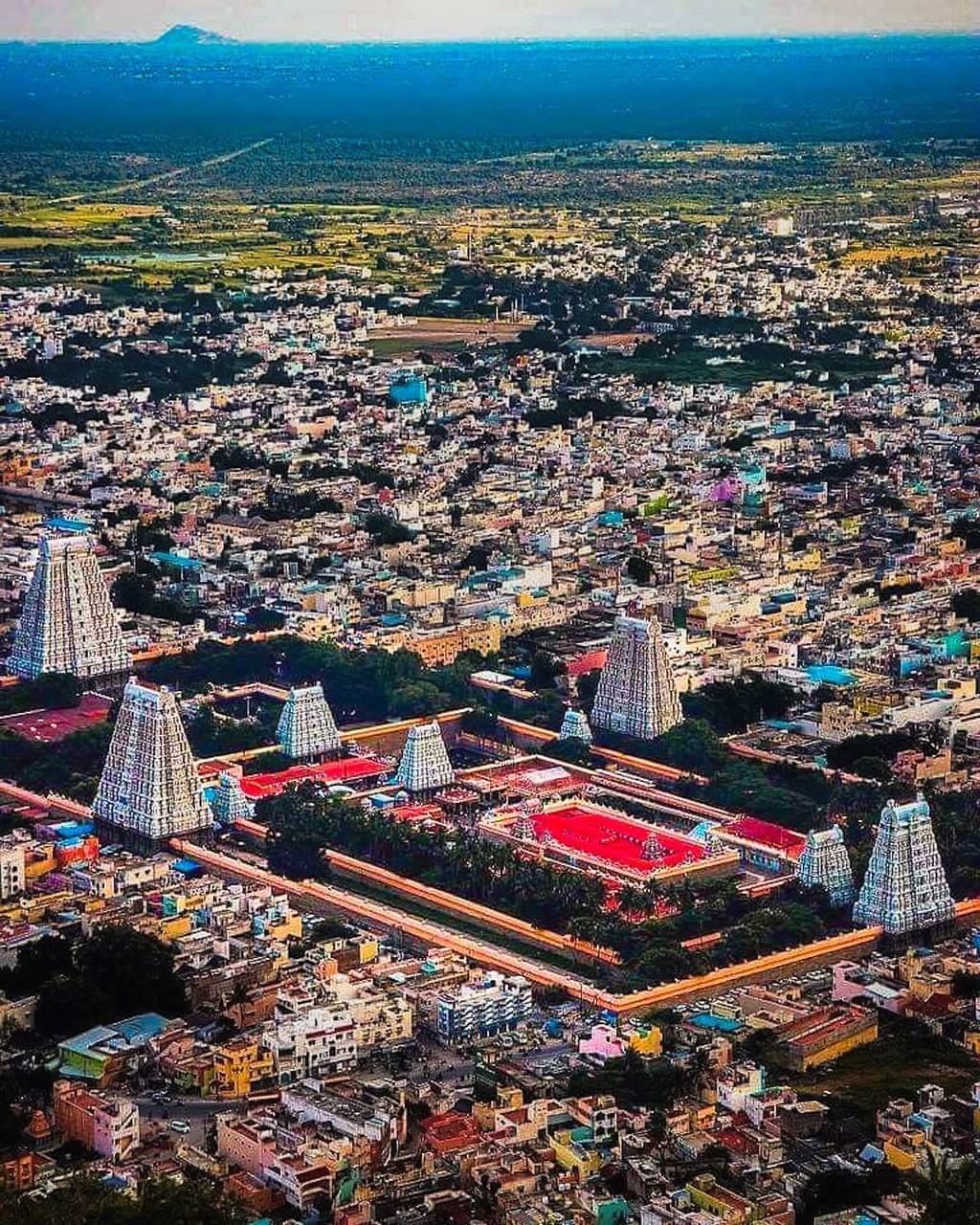
Tiruvannamalai, the city of Shiva, symbolizes one of the five elements of the universe – Fire.
The city formed around the sacred hill of light, Arunachala. Arunachala is revered as the self-manifested Shiva Lingam, older than the Himalayas. It is said that Shiva manifested himself as Arunachala, making this place one of deep transformation. Being near this hill or meditating on it leads to liberation from suffering and the cycle of rebirth.
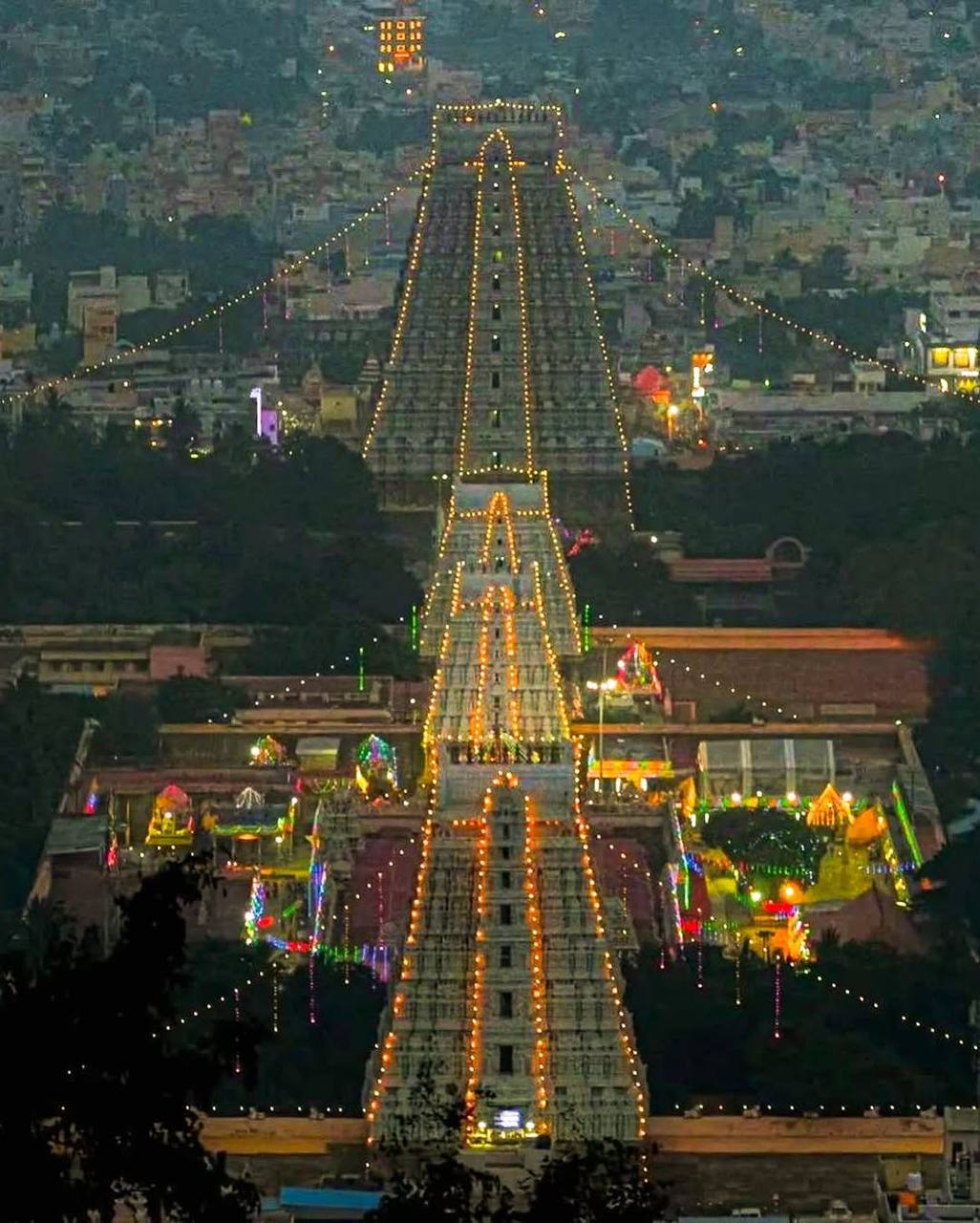
Tiruvannamalai’s temple Arunachaleswara is one of the highest in India, and its age remains unknown, though inscriptions date back to the 10th century. This temple is one of the five Panchabhuta Sthalams (the five great temples associated with the five primary elements). Here lies the Fire Lingam.
The temple also holds a sacred Nandi bull, who lovingly gazes at Shiva, and it is said that if you whisper your wishes into his ear, he will carry them to Shiva, and they will surely come true. -
Chidambaram – Nataraja Temple – Ether Lingam
Chidambaram, once the capital of the Chola Empire, is the third sacred city of Tamil Nadu. The famous Shiva temple here is dedicated to Nataraja, Shiva as the cosmic dancer.
The main sanctuary of the temple houses the mystery of the five elements through five sacred Shiva Lingams. The most famous is the Akashalingam (Ether Lingam), known as “rahasya” (the mystery). The Ether, permeating all living space, gives the vibration of life’s rhythm.
Once every 12 years, the hidden Lingam is revealed during specific rituals. The temple also features a crystal Lingam, Chandramaulishwara, which Shiva created from moonlight.
Chidambaram is believed to lead its devotees to moksha, liberation. -
Tiruchirapalli – Jambukeshwara Temple – Water Lingam
The Jambukeshwara Temple is one of the oldest temples in India (around 1800 years old), covering 7 hectares.
It represents the element of Water.
Here, Shiva is worshipped in the form of the Appu, or Water Lingam. An endless spring of water flows beneath the Lingam. According to legend, the goddess Parvati, performing penance here, worshiped Shiva in the form of a Water Lingam. Shiva was pleased with her penance and appeared before her to impart the highest knowledge – Shiva Jnana.
Since Shiva and Parvati are not husband and wife here, but Teacher and Student, their deities are placed not next to each other, as usual, but opposite one another. Water symbolizes knowledge and wisdom, and its flow represents the process of gaining knowledge. -
Kalahasti – Kalahastishwara Temple – Air Lingam
The Kalahasti Temple symbolizes the element of Air.
Here, Shiva is worshipped in the form of the Vayu Lingam.
In the main sanctuary, a lamp burns, its flame constantly swaying under the influence of the wind, even when the doors are closed and there are no windows. The Lingam is white and considered Swayambhu (self-manifested).
Air symbolizes life. Where there is no air, there is no life. In this temple, Shiva blesses all living beings with his presence, just like air.
This ancient temple, whose earliest structures were built in the 5th century, holds immense spiritual significance.